If you are getting interest from modeling agencies, you will have to navigate contract negotiations. In this article, I share tangible tips for you to be aware of, as you read through your modeling contract and decide what you want to negotiate.
Understand the Entire Modeling Contract
Modeling agency contracts can be long! Make sure you have a full understanding of the entire contract–from commission rates, contract duration, exclusivity clauses, termination rights, to name a few.
Is there a parallel between what the agent has promised you in an initial conversation and what you are seeing in the contract? For any questions you have, schedule a meeting, or write out a detailed email asking about each clause you are confused about in the contract.
I have been offered a number of contracts over my career. Sometimes I send detailed emails asking for clarification about certain clauses, and the agent responds to each question in-line, in the email.
Other times I have scheduled a meeting with the agent with all of my questions prepared about specific clauses in the contract. I also ask them in what scenarios they have implemented certain clauses so I understand the tangible reasons why they exist in the contract.
This may or may not be the norm, but as a model who doesn’t have a Mother Agency as a sounding board, it’s very important I understand every clause and know what I am signing.
Know What you Want
Before you begin negotiating a contract, It can be hard to know what to ask for if this is your first agency contract.
Are you okay with exclusivity? Do you want the ability to freelance outside agency bookings?
Does your contract cover UGC bookings, but you already have a social media following? Read on for specific terms I often look for before signing a contract.
A few points I have clarity on before I sign a modeling contract.
Here are some points I am always aware of before I sign a modeling contract. I talk more about this in depth in my article about what to know before signing a model agency contract.
How long is your contract?
As a commercial model, 1 year contract is ideal. A contract longer than 2 years is…a bit long, for me. I would never sign a contract longer than 3 years. You can always resign a shorter contract if the partnership is going well.
If you’re booking regular work for an agency, they will be keen to resign you. If you’re not, you might as well look for another agency that has clients who would be a better fit for your look. Getting out of a contract before the terms are up is often a bit more complicated, than resigning a contract frequently.
I always negotiate to have agency fees to be taken out of my first booking
Do you want an exclusive or non-exclusive contract?
If exclusive, is your agency going to act as your Mother Agency? What are the exclusivity terms? Does it include Social media/UGC jobs?
The drawback of exclusive contracts is that if you’re not booking for an extended period of time, you can’t try to find work on your own. You can’t seek out other agencies for work. You’re effectively stuck, unless you ask to terminate the contract.
The best chance at becoming a working model is to be signed with multiple agencies across different markets.
That’s why for experienced commercial models, a non-exclusive contract is typically more beneficial to them than an exclusive contract. While you might not get much 1-1 attention, the agent should be willing to provide guidance in any way that will increase the chances of you getting booked. The more you work, the more money they make.
I’d say the main exception to this is if you have a mother agency contract from an agent that you think will be able to develop you and place you in many different markets. One way to gauge this is to find a mother agent whose main source of income is from placing you with other booking agencies, rather than booking you jobs.
Exclusivity in a modeling contract is tougher to negotiate, since agencies as a whole typically offer only non-exclusive or only exclusive contracts to new models. You often don’t know which it is until you’ve had an interview with them. Most talent agencies offer non-exclusive contracts, some of which include Vie Agency, Stewart Agency, and Bella Agency.
I know a number of models with these agencies who have non-exclusive contracts with them, and work with other agencies in the same market. These agencies focus on booking work for their models as compared to development, so they prefer models that already have a marketable portfolio.
When do you pay fees?
Any fees I have to pay to the agency (visa preparation fees, website fees, etc) I negotiate for them to take out of my first booking. That way I don’t pay any upfront fees when I sign, and if, for whatever reason, I don’t book any jobs that year, I don’t pay any fees.
The only caveat to this, is if the agent determines I need comp cards, or a book update, in which case, I pay those fees directly to the printer or the creatives (photographer, makeup artist, stylist) involved in the shoot.
You should never have to pay any fees before you sign your contract.
If you ever pay a fee before you sign a contract, that is a red flag. Major scammy vibes. Agencies might sell these fees as “photoshoot fees,” “website fees,” or “modeling classes,” amounting to thousands of dollars of investment.
Some of these agencies act as mother agencies and have placed successful models in large markets with famous agencies. It simply happens that they also make money from selling photoshoots and modeling classes to aspiring models.
Reputable mother agents should be excited to sign you, and be willing to develop you for “free.” They get a return on their investment when you get placed and start booking with secondary agents.
Ask other models what they wish they negotiated
Often new models–either to an agency or the industry don’t know what to negotiate until they’ve experienced something that they wish they had negotiated in the contract. As soon as an agency has reached out to you for a meeting, start reaching out to models signed with the agency to get a sense of how they feel working with them.
There’s a chance you don’t get much response–I typically get a 30% – 60% response rate, depending on the agency and market I’m research for.
To be fair, I feel like asking models what they wish they had negotiated is quite a personal question, so I often start off the interaction with something like the below:
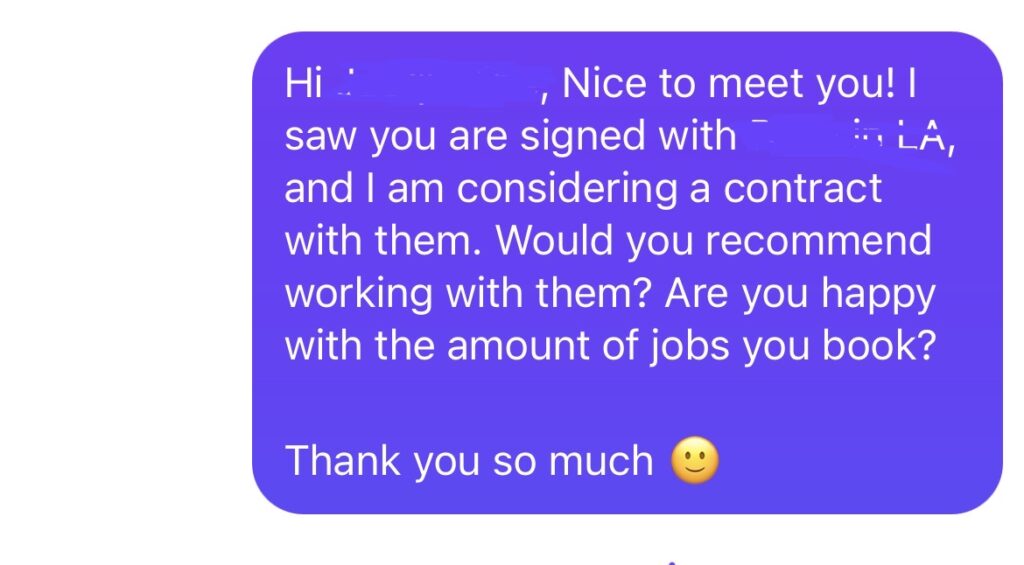
If they are open to sharing more information, eventually I will ask them if there is anything they wish they had negotiated in their contract.
What happens if the agent says no to your requests?
There’s a chance the agent says no to every point that you negotiate. Either way, it’s still important to ask. They will not rescind your contract because you ask for terms that you deem make the contract more fair to you. If they do, you do not want to be partnered with an agency that does not support you advocating for yourself. As a model, you may need to advocate for yourself on set, and you’ll want your agent’s support when you do.
Your power lies in your willingness to walk away. If the agency says no to your requests, it’s up to you to decide if the contract is worth it. Use the information from your conversations, email interactions, and online research to determine whether you think you’ll book work through them, and whether they will be a good support for you as you build your career.
Key Takeaways
The most important part of contract negotiations is knowing what to ask for. Particularly if this is your first agency contract, review everything you’re given. Don’t be afraid to ask your agent questions. Reach out to other models with the agency, and ask them for guidance. Don’t be afraid to walk away. You’d rather be unsigned, and reapply to agencies in 4 – 6 months, than be stuck in a multi-year contract where you aren’t working and aren’t growing as a model.


Leave a Reply